
Starting in the 2026–2027 school year, Ontario students must achieve a minimum score of 70% on a financial literacy assessment as part of the requirements for earning their Ontario Secondary School Diploma (OSSD). The assessment is completed during the compulsory Grade 10 Career Studies course (GLC2O).
For teachers, the challenge goes beyond preparing students to pass a test. It’s about helping young people understand how to earn, save, spend, and borrow money responsibly—and giving them opportunities to practise making financial decisions before they’re responsible for managing their own finances.
This guide explains what Ontario’s new financial literacy graduation requirement involves, the concepts students are expected to understand, and practical ways educators can prepare their classrooms.
What Is Ontario’s New Financial Literacy Graduation Requirement?
Ontario’s requirement is designed to ensure students leave high school with foundational money management knowledge. Developed by TVO, the financial literacy learning modules and assessment questions cover concepts introduced throughout Grades 1–9, including saving, budgeting, credit, debt, and consumer awareness.
The assessment is integrated into Career Studies rather than requiring students to complete an additional financial literacy course.
Here are the key details teachers should know:
| Requirement | Details |
|---|---|
| Implementation | 2026–2027 school year |
| Eligible Students | Students who entered Grade 9 in 2025–2026 or later |
| Course | Grade 10 Career Studies (GLC2O) |
| Minimum Passing Grade | 70% |
| Assessment Provider | TVO |
| Attempts | Two during the Career Studies course |
| Course Grade Weighting | 5% of the final Career Studies mark |
Once a student successfully completes the requirement, it is recorded on their Ontario Student Transcript.
Who Needs to Complete the Requirement?
The requirement generally applies to students who entered Grade 9 in September 2025 or later. Most students in this group will complete the assessment during Grade 10 Career Studies, beginning in the 2026–2027 school year.
Some exceptions apply. For example, students who completed Career Studies before September 2026 are not required to complete the new assessment. There are also specific exemptions related to certain mathematics pathways and students transferring into Ontario schools.
Teachers and school administrators should consult the Ontario Ministry of Education’s official financial literacy guidance for current eligibility rules and exemptions.
What Topics Are Covered on the Ontario Financial Literacy Assessment?
Ontario’s financial literacy assessment evaluates students’ understanding of money management concepts they will encounter throughout their lives.
According to TVO Learn’s Financial Literacy Graduation Requirement resources, the assessment covers budgeting, interest rates, earning and saving, taxes, credit and debt, consumer awareness, and financial fraud.
These topics are closely connected. Understanding how much money is available to spend, for example, requires students to recognize the difference between gross and net income. Making responsible borrowing decisions requires an understanding of interest, repayment obligations, and the impact of debt on a budget.
Budgeting and managing expenses involves understanding how to allocate limited income among essential expenses, discretionary spending, and savings. Students should recognize why a spending plan matters and how changing circumstances can affect financial priorities.
Earning and saving money introduces the relationship between employment income, spending decisions, and financial goals. Students should understand why setting money aside regularly can help them prepare for both expected expenses and unexpected financial challenges.
Interest rates affect savings and borrowing in different ways. Interest earned on savings can help money grow over time, while interest charged on debt increases the total cost of borrowing. Understanding this distinction is fundamental to evaluating financial products.
Taxes help students understand why their take-home pay may be lower than their gross earnings and how taxation affects their personal finances.
Credit and debt introduce the responsibilities that come with borrowing money. Students should recognize that access to credit creates financial obligations and that interest rates, repayment schedules, and borrowing costs matter.
Consumer awareness involves making informed purchasing decisions, comparing options, and recognizing the difference between needs and wants.
Financial fraud and scams address the importance of protecting personal information and recognizing situations that could put someone’s money or financial identity at risk.
Together, these topics provide a practical foundation for financial independence.
What Financial Skills Should Grade 10 Students Practise?
One of the most valuable things students can learn about personal finance is that building financial security isn’t necessarily about how much money they earn. It’s about the decisions they make with the money they have.
Consider a student who has just started earning income from a part-time job. They could spend everything they earn, or they could begin developing a habit that will serve them for years to come: Pay Yourself First.
This simple principle encourages students to prioritize saving before spending on non-essential purchases.
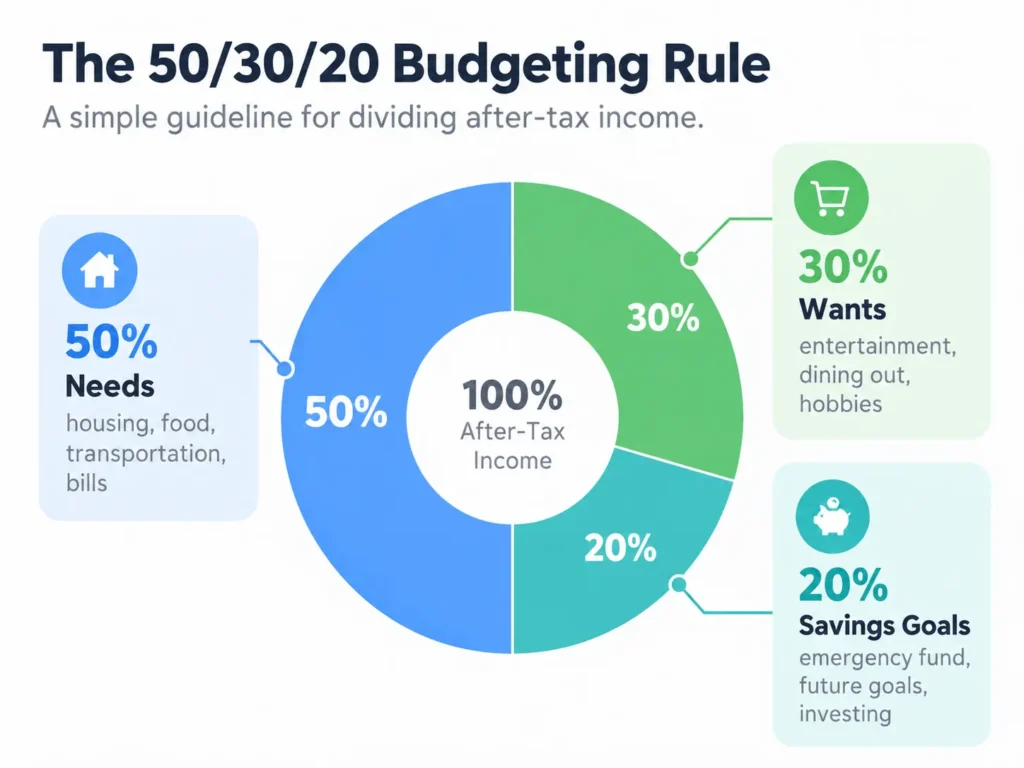
Teachers can introduce the 50/30/20 budgeting rule, which divides after-tax income into three categories: 50% for needs, 30% for wants, and 20% for savings goals.
Students can practise allocating their income and then explore what happens when their expenses exceed their budget.
But a budget is only part of the picture. Students should also understand why saving early matters.
Through lessons on the power of compound interest, students discover how money can grow when interest or investment returns are reinvested over time. Comparing someone who starts investing at age 18 with someone who waits until age 30 helps illustrate how time can influence long-term financial outcomes, even when the later investor contributes more each month. Investment returns are not guaranteed, but the example reinforces the potential advantage of starting early.
Another essential skill is understanding the true cost of borrowing. A student might be able to afford the monthly payment on a car loan, but have they considered the interest they’ll pay over the life of the loan, along with insurance, maintenance, and other ownership costs? Similarly, understanding how credit cards work helps students recognize why carrying a balance and making only minimum payments can make purchases much more expensive.
Students also benefit from learning how to protect themselves financially. Building an emergency fund, understanding insurance, recognizing scams, and managing debt responsibly all contribute to their ability to handle unexpected challenges.
These concepts are most meaningful when students have opportunities to put them into practice. Through financial literacy lessons and interactive simulations, teachers can help students experience the consequences of their choices, develop healthy financial habits, and build the confidence to make informed decisions about money.
The goal isn’t simply to prepare students to answer questions on an assessment. It’s to help them recognize the financial decisions they’ll face and give them the knowledge to approach those decisions with confidence.
How Does the Financial Literacy Requirement Fit Into GLC2O Career Studies?
Ontario’s Grade 10 Career Studies course (GLC2O) already includes important connections between career planning and financial responsibility. Through Strand C2: Budgeting and Financial Management, students explore how financial decisions affect their education, career pathways, and future goals.
The new financial literacy graduation requirement complements this curriculum by assessing foundational money management concepts introduced in earlier grades. While the TVO assessment is a separate requirement, Career Studies provides an opportunity to reinforce those concepts through practical financial activities.
To help teachers connect these learning objectives, PersonalFinanceLab has mapped relevant lessons and interactive simulations to Ontario’s GLC2O curriculum expectations.
How Can Teachers Prepare Students for Ontario’s Financial Literacy Requirement?
1. Start With Practical Financial Literacy Lessons
The most effective financial literacy lessons connect a financial concept to a decision students can recognize.
For example, when introducing saving, students can explore the difference between putting money aside for a short-term purchase and building an emergency fund to cover unexpected expenses. This helps them understand that saving is not simply about accumulating money; it’s about creating financial flexibility.
When learning about interest, students should see both sides of the equation. Compound interest can help savings and investments grow, but high-interest debt can also become increasingly expensive when balances are left unpaid.
And when discussing credit, students can compare two approaches: someone who pays their credit card balance in full each month and someone who regularly carries a balance, incurs interest charges, and struggles to keep up with payments.
These comparisons give financial concepts context and encourage students to think about the long-term effects of their choices.
Teachers can then reinforce the principles through short activities, calculations, and classroom discussions before asking students to apply what they’ve learned independently.
2. Give Students Hands-On Budgeting Experience

What does it really take to manage your money month after month? The PersonalFinanceLab Budget Game gives students a chance to find out by stepping into a simulated financial life.
Students take on the role of a college student working part-time or a young adult working full-time. Over a series of simulated months, they earn paycheques, manage household expenses, pay bills, use credit, and work toward financial goals.
But the experience goes well beyond balancing a spreadsheet.
Students choose where to live, how much to spend on groceries, and which phone and internet plans they can afford. They decide whether to pick up extra shifts at work, study to improve their future earning potential, take care of household responsibilities, or spend time socializing with friends.
Along the way, unexpected situations challenge their plans. A decision to adopt a pet, for example, may bring years of companionship but also introduces ongoing expenses and potential veterinary bills. Changing apartments or cancelling a service can mean paying additional fees.
The game moves students through these experiences at an accelerated pace, allowing them to see how decisions made today can affect their financial position months later.
And because success isn’t measured by savings alone, students must also consider their quality of life. Choosing the cheapest option isn’t always the best strategy. The challenge is finding a sustainable balance between financial responsibility and enjoying life.
At the end of each simulated month, students receive feedback on their savings goals, bill payments, credit management, and overall progress. They can use those insights to adjust their approach as they move through the game.
For teachers, it’s an opportunity to move beyond explaining financial concepts and let students discover how managing money actually works through experience.
3. Reinforce Learning Through Financial Decisions
The Budget Game also incorporates short challenges that turn everyday financial decisions into opportunities to practise useful skills.
In a grocery shopping challenge, students compare products by price, quantity, and quality to identify the best value. They quickly discover that the lowest price doesn’t necessarily mean the best deal.
Other activities challenge students to earn additional income through a simulated part-time job or plan a weekend within their available time and money.
These experiences help connect financial knowledge to familiar decisions. Students aren’t just learning what a budget is; they’re practising how to shop wisely, manage competing priorities, and make the most of limited resources.
Short financial lessons are also integrated into the game, introducing concepts students can immediately apply to improve their financial decisions.
This combination of instruction, practice, and feedback helps students see financial literacy as a practical skill rather than an isolated classroom subject.
4. Check Understanding Before the Assessment
Knowing where students are starting, identifying gaps in their understanding, and measuring their progress are all important parts of preparing for Ontario’s financial literacy graduation requirement.
PersonalFinanceLab incorporates several forms of assessment throughout the learning experience, giving teachers opportunities to evaluate students’ knowledge without having to create additional tests or quizzes.
Teachers can begin with our 15-question Pre-Test, which establishes a baseline of students’ understanding of credit, investing, saving, and income. At the end of the learning experience, students complete a Post-Test using the same questions, allowing teachers to measure how their financial knowledge has improved.
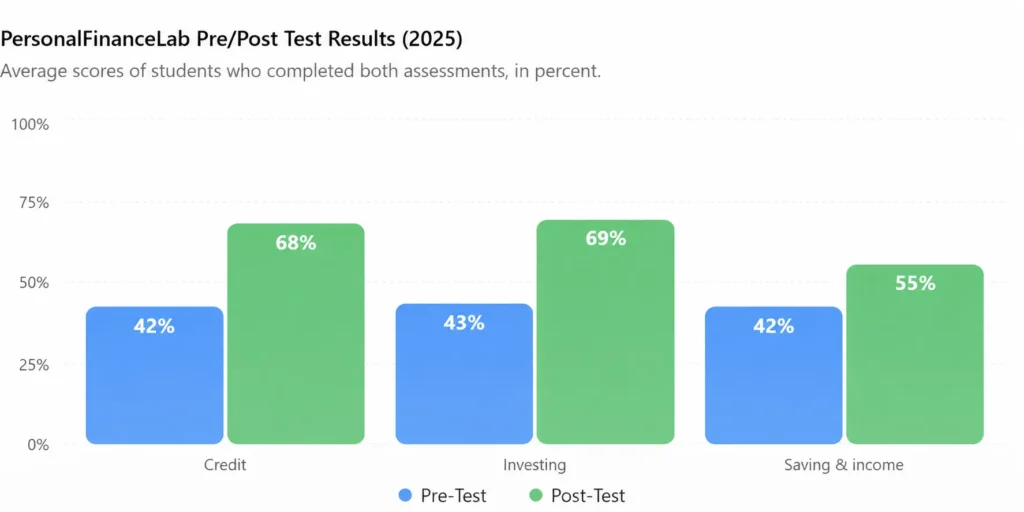
Our 2025 Pre/Post Test results demonstrate the value of this approach. Across participating students who completed both assessments, average scores increased from 42% to 68% in credit, 43% to 69% in investing, and 42% to 55% in saving and income.
Assessment is also woven directly into the Budget Game. As students move through their simulated financial lives, short pop-up lessons introduce important financial concepts that they can apply to their decisions in the game. Students can reinforce their understanding through the Wealth Whiz Quiz, an interactive, game show-style challenge featuring 10 randomly selected financial literacy questions. They receive immediate feedback on their answers and earn game points based on their performance, making knowledge checks part of the experience.
Beyond the simulations, every lesson in our Learn Center concludes with a self-grading pop quiz. These quizzes help reinforce key concepts and give students another opportunity to demonstrate what they’ve learned.
Together, these assessments allow teachers to establish a starting point, reinforce understanding throughout instruction, and evaluate progress over time.
While PersonalFinanceLab’s assessments do not replace Ontario’s official TVO financial literacy graduation assessment, they provide valuable opportunities to identify knowledge gaps, monitor learning, and help students build confidence before completing the provincial requirement.
Financial Literacy Teaching Resources for Ontario Grade 10 Classrooms
Bringing financial literacy into the classroom doesn’t have to mean developing an entirely new collection of lessons and assessments.
PersonalFinanceLab provides Canadian-focused financial literacy lessons, interactive simulations, and teaching resources that can be incorporated into existing Career Studies instruction.
Teachers can customize the Budget Game to suit their instructional goals, including adjusting wages, living expenses, starting balances, and the length of the simulation. Additional scenarios involving taxes, insurance, and how to build a virtual stock portfolio can reinforce specific classroom topics.
Our learning library complements these experiences with lessons on Canadian banking, saving, financial resilience, consumer protection, and planning for postsecondary education. For classes exploring investing, the Stock Game lets students manage a virtual portfolio without risking real money.
With ready-to-use lessons, interactive experiences, and integrated assessment tools, teachers can select activities that suit their students and available classroom time.
We’ve also mapped relevant PersonalFinanceLab activities to Ontario’s GLC2O Career Studies expectations, making it easier to identify curriculum-aligned resources.
Frequently Asked Questions
Is financial literacy mandatory for Ontario high school students?
Yes. Beginning in the 2026–2027 school year, students who entered Grade 9 in 2025–2026 or later generally must complete Ontario’s financial literacy graduation requirement to earn an Ontario Secondary School Diploma (OSSD).
Students complete the requirement as part of their compulsory Grade 10 Career Studies course. Certain exemptions apply, so schools should consult the Ministry of Education’s official guidance.
What grade do Ontario students need to pass the financial literacy requirement?
Students must achieve a minimum score of 70% on the official financial literacy modules to meet the graduation requirement.
They have two attempts during their Grade 10 Career Studies course. The highest attempt mark counts toward 5% of their final course grade.
Students who do not meet the requirement during the course have access to alternative completion options and additional support.
Is there a separate financial literacy course in Ontario?
No separate financial literacy course is required specifically to fulfill the new graduation requirement.
Students complete the mandatory financial literacy modules and assessment questions within their existing Grade 10 Career Studies course (GLC2O).
Financial literacy is also taught in earlier grades, including Ontario’s elementary and Grade 9 mathematics curricula. The graduation requirement assesses concepts introduced during those earlier years.
What happens if a student fails the financial literacy assessment?
Students who do not achieve 70% on their first attempt have another opportunity to complete the requirement during Career Studies.
Before the second attempt, students can review additional learning resources and receive support from their school.
If they are unsuccessful after both in-course attempts, schools must provide alternative ways to meet the graduation requirement. These can include further supervised attempts, additional instructional support, or TVO-developed learning activities that serve as an equivalent pathway.
Students should work with their school to determine the appropriate next steps.
Where can teachers find Ontario financial literacy practice resources?
Teachers should begin with TVO Learn’s official financial literacy resources, which provide information and supporting materials for the provincial requirement.
For additional classroom instruction, PersonalFinanceLab offers Canadian financial literacy lessons, budgeting simulations, and student activities that reinforce foundational money management skills.
Teachers can review the Ontario GLC2O curriculum alignment to identify lessons and activities that complement their Career Studies instruction.
Helping Ontario Students Build Financial Confidence
Ontario’s financial literacy graduation requirement establishes an important expectation: students should leave high school with a basic understanding of how to manage their money.
But passing an assessment is only one part of becoming financially capable.
When students have opportunities to create budgets, compare financial options, practise saving, and learn from simulated decisions, financial literacy becomes more than a collection of concepts to remember. It becomes a set of skills they can begin using in their everyday lives.
By combining clear instruction with meaningful practice, Ontario teachers can help students prepare for the graduation requirement while building financial confidence that extends well beyond the classroom.
Discover how PersonalFinanceLab supports Ontario’s Grade 10 Career Studies curriculum through aligned lessons, interactive financial simulations, and practical teaching resources.